Sunday, April 24, 2011

The Peach Orchard

      
"Nature does not hurry, yet everything is accomplished." -Lao Tzu

  For this assignment, I chose to watch the section from the movie "Dreams", entitled "The Peach Orchard. About two minutes into the film, I start seeing eerie similarities to modern day Japanese horror films that Americans seem to love. I keep watching and waiting for the girl from "The Ring" to pop out of the ceiling. Aside from being what I would call "cheezy", the film showed many religious aspects.
         The section of the film "The Peach Orchard", was very symbolic of the Shinto belief in Kami. The term Kami refers to the Shinto belief that everything is spiritual; therefore, there is a parallel between humans, nature and the gods. This belief was very evident in the scene of the boy in the peach orchard. In this particular scene, the boy follows a "goddess" into the peach orchard where he is met by several gods and goddesses. The boy begs to the gods and goddesses to bring back his beloved peach orchard one last time. The boy confesses his admiration for the orchard and the spirits work hand in hand to bring back the peach orchard in full bloom. This scene shows the connection between man, nature and the spirits in a powerful way.
        The peach orchard itself is also a symbol of the Shinto belief in Kami. The Shinto belief in Kami is also expressed through the connection between matter and spirit. According to Shinto belief, matter and spirit are present in all things, they are not separate entities. For this particular scene, the peach trees hold a spiritual meaning for the little boy. The boy expresses his admiration for the fruit trees and believes them to hold special powers. One could say that the peach orchard is a "spiritual refuge" of some sort, with deep meaning.

Sunday, April 17, 2011

Winnie-The-Taoist?

In response to The Tao of Pooh, by Benjamin Hoff
      "Cleverness, after all, has its limitations. Its mechanical judgements and clever remarks prove to be inaccurate with passing time, because it does not look very deeply into things to begin with". (37)  Maybe its just me. Maybe it's my own fault that I found this book stupid, but the "cleverness" of using familiar characters such as Winnie the Pooh and friends to explain Taoist principles left me with a lot of questions and even more confused than I already was to begin with. I found myself reading the passages over and over again trying to connect the stories with the Taoist principle that was trying to be explained in each chapter. While I do appreciate the author trying to "dumb down" Taoism, I do not like how he went about doing it. Maybe I am just not smart enough to follow "Taoism for Dummies."
     
      In response to the “Bisy Backson” chapter of The Tao of Pooh, I found a quote at the very beggininng of the chapter that perfectly describes the “busy backson” American culture.  “ Thinking that he was going too slowly, he ran faster and faster without stopping, until he finally collapsed from exhaustion and died.” (92) This quote perfectly descibes busy American culture. We are constanly in high gear trying to get things done. We are constantly on the move, in search of bigger and better. We never take the time to slow down and really see what is happening around us. As an American, I should be insulted by the critique of Americans as “Bisy Backsons”, but really, its all true, sadly. Hoff suggests that there is a “cure” to being a “Backson” in order to stray away from becoming a “Backson”, one must do opposite of a “Backson”. “Let’s put it this way: if you want to be healthy, relaxed, and contented, just watch what a Bisy Backson does and then do the opposite.” (95)  I guess there’s no saving me, I’m a natural born Bisy Backson. 
          I do not believe that Taoism is a “solution” to America’s “problem.” From reading this book, I did not really understand what the author was suggesting our “problem” is. Taoism itself is not the solution that we need to solve our so called “problems.” Though some Taoist principles may help in solving some of the predicaments that we seem to get outselves in, Taoism as a religious study would not help. We all need to help eachother and in doing so, much more will be able to be accomplished. There is no way that all Americans would settle on Taoism to solve our problems.


Monday, March 7, 2011

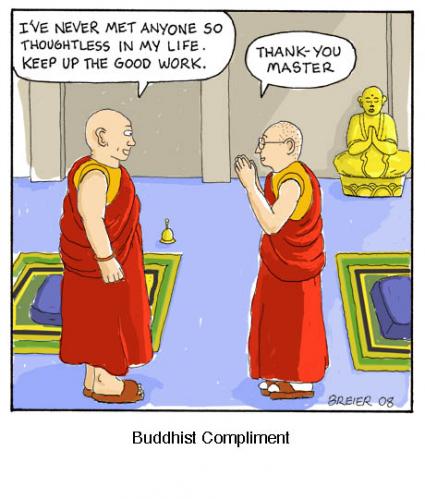
Thoughtless

   
        By definition, a stereotype is a popular belief about a specific group of people. Further research into what makes up a specific stereotype finds that stereotypes can either be positive or negative. For this particular assignment, I found there to be an equal number of images that depict Buddhists in both a positive and negative way. For this assignment, I chose an image depicting Buddhism in a negative manner. The image shows a Buddhist master paying a compliment to one of his students. The Master tells the student that he has never seen someone so thoughtless. Delighted with the compliment, the student graciously thanks his Master.  This particular image misleads non-Buddhist into thinking that all Buddhist followers are thoughtless. When someone does not study Buddhism, they might take this depiction the wrong way. The American definition of someone who is thoughtless might be someone who only thinks about themselves or someone that might be stupid. For Buddhists, being thoughtless means having controlled thoughts, a completely different understanding from western cultures. 
        According to the website, The Basic Teachings of Buddhism , control of the mind is very important. Emphasis is placed on controlling your thoughts to only one subject at a time, or to free your mind from any thoughts at all and just "be as you are". By controlling one's thoughts, one can be truly at peace. Mind control can be practiced through meditation and breathing exercises. By focus on breathing, the mind does not wander. '
        In Brad Warner's book, Zen Wrapped in Karma Dipped in Chocolate, there are many instances where he exposes the stereotypes that Americans place on Buddhism. In chapter 6, "The Abuse of Power in Zen", Brad talks about how many Zen Masters abuse their knowledge of Buddhism to profit on those who are drawn to its practices. In my opinion, this mis- information only allows these so called "Zen Masters" to profit on things that they really do not know anything about; therefore, reinforcing the stereotypes that Americans have of Buddhist followers. "Too often the spiritual leader will try his best to be what his followers expect him to be. He may do so because he's full of himself and truly believes that he is god's gift to the world. But usually that's not the case." (p 35) A true Buddhist teacher would not think that they were god's gift to the world. They would simply believe that their purpose in life is to teach Buddhist principles and spread messages of good will towards man. Why would someone fall for this? Doesn't this just reinforce a stereotype?

Sunday, February 13, 2011

Songs about Success
1.) "The Thrill" Wiz Khalifa
2.) "I Made It" Kevin Rudolph
3.) "Lucky" Britney Spears
4.) "That Was A Crazy Game of Poker" OAR
5.) "Billionaire" Travie McCoy FT. Bruno Mars


Songs about Liberation
1.) "King Without A Crown" Matisyahu
2.) "Redemption Song" Bob Marley
3.) "Who Says" John Mayer
4.) "Let Her Cry" Hootie and the Blowfish
5.) "Learn to Fly" Foo Fighters


     For this assignment, I found the aim of to be more prevalent than the aim of liberation. Everyone wants to find success in one way or another, so there is no wonder that there are numerous songs about finding it. The aim of success reaches across all genres. From country to rap, one can find something about the journey to, in midst of, or fall from success. I believe this to be true, due to the nature of humankind. We are taught from a young age that success in life will bring the greatest happiness. Success comes in many different forms and definitions. For one, success might come in the form of a loving marriage, for others it might be a high paying job with a corner office. Though these forms of success differ, there is one common goal. Happiness.
     Unlike the Western view on Success, the Hindu view stresses that success will never be enough, and it is not truly what you want. Success may be something that you want to achieve on your way to "Ultimate Reality", but simply being successful will never truly fulfill you and be "enough" to satisfy the needs of a person. For many Americans, success is enough for them to be happy. An American's view of  "Ultimate reality" may be the 4 million dollar mansion with a 5 car garage. The material things truly fulfill them and there is nothing else that could possibly make them any happier. In my opinion, the Hindu view on success is much more realistic and down to earth. As Americans, we are a consumer culture and material wealth is a means of great success. It is hard for us to comprehend that material wealth or power is simply not enough to fulfill a great life. It is important to remember that great success will not bring you fulfillment.

Sunday, February 6, 2011

Aims of Pleasure and Community Service

Pleasure Songs


Corey Smith "Drinkin Again"
Pepper "No Control"
Benji Davis Project "Do It With The Lights On"
Bob Marley "Is This Love"
Soul Decision "Faded"


Community Service Songs


Matisyahu "Youth"
Soja "Open My Eyes"
Jack Johnson "Good People"
Bob Marley "One Love"
Jackie DeShannon "Put A Little Love In Your Heart"


For this assignment, I found the aim of pleasure to be much more prevalent than its community service counterpart. When it comes to the aim of pleasure, it is much easier to find themes of sex, drugs and alcohol, rather than themes of community involvement and good will. American media has taught us that "sex sells" and sex, in fact is everywhere. Every aspect of our media coverage has something to do with sex, in all forms. Drug and alcohol usage among Americans is at an all time high. We are bombarded with these images in everyday life and value has been placed on attaining pleasure through the use of these addictive substances. In Hinduism, in order to attain pleasure, one must "seek intelligently", as if to use their morals as a guide to what activities are appropriate, yet fulfilling.  The Eastern view on pleasure seem much more morally sound and appropriate. I feel that Western views should take influence from their Eastern counterparts and realize that not everything needs to be so sexually explicit or drug and profanity laced. The more wholesome, Eastern view is where we should seek guidance. While I was able to find many songs that emphasized pleasure, I found it surprising that there aren't very many sons about community service or good will. I spent hours going through songs, analyzing lyrics and trying to determine if the song could appropriately be categorized as the aim for community service. While it was hard to find songs to fit this particular aim, the ones that I did find seem to be very appropriate for the topic. As Americans, we are slowly trying to put more emphasis on the importance of service to your community and mankind as a whole. There are many media outlets that try to spread the word of good will and service in a fun and entertaining way that attracts people young and old to the ideas of  social responsibility. Though the Hindu view on community is much different than that of Americans, some ideas are still the same. Community is very important and the power of the community is something that we can put trust in, even if all else fails